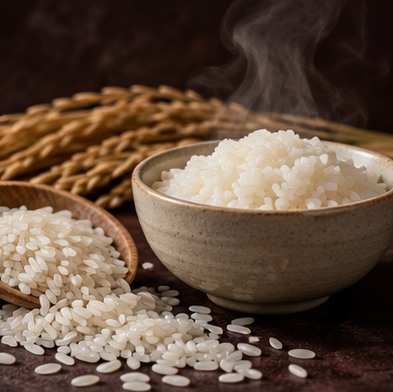
Rice in perfume is a study in understated detail. Instead of a loud dessert association, a composition may suggest a warm bowl of grain, a hint of steam, a dry starchy texture or a soft milky background. The appeal often lies in the space between these impressions. Rice also illustrates how an everyday sensory reference can support an elaborate fragrance idea without needing to resemble a literal food preparation.
What does a rice fragrance try to capture?
Grain-like, softly nutty, steamed and milky are useful directions, but each points to something slightly different. Steam suggests an airy atmosphere; grain suggests texture; milk suggests smoothness. A perfume might connect all three, or choose only one. Separating them helps explain why a scent marketed around rice can feel floral, woody or musky rather than obviously gourmand.
Rice accord versus rice as a physical ingredient
The note name does not establish that cooked rice, rice water or a particular rice extract is in the perfume. A perfumer can compose a recognisable effect from fragrance materials. Diptyque explicitly describes a rice-steam accord within L’Eau Papier, set beside white musks, mimosa and blonde-wood effects. That terminology is informative: it describes an impression and its setting rather than a bowl of rice added to the formula.
A different documented interpretation
d’Annam presents White Rice as a tribute to the rice reference within Vietnamese life and lists rice alongside pandan, orris, jasmine, tonka bean and white musk. Its description emphasises the relationship between softness and a grain-like structure. This gives a reader another example to study, without assuming that a national or culinary association has one universal olfactory meaning for every wearer.
Why grains matter in the 2026 gourmand discussion
The Perfume Society’s 2026 outlook discusses toasted grains and tea-related textures within a more varied gourmand vocabulary. Rice is useful in that conversation because it permits an edible association without requiring a confectionery effect. Editorial trend interest should not be mistaken for a claim that rice-inspired perfumery began this year. The creative possibilities matter more than a novelty label.
A careful way to sample the effect
Compare rice-inspired perfume with a lactonic perfume and a powdery floral, using separate labelled blotters. Ask whether the softness feels creamy, powdery or grain-like. Then look for the background: woods can give the impression a dry outline, while floral effects may make it more luminous. Let your description stay specific. Quiet does not necessarily mean weak, and a rice theme does not predict the performance of every formula.
Common questions
Does rice perfume smell like cooked rice?
Some compositions deliberately evoke steamed rice; others use grain-like, powdery or milky effects more abstractly.
Are rice notes the same as milk notes?
No. They can overlap in a fragrance, but grain-like or steamed impressions are different from a creamy lactonic texture.
Sources and further reading
Trend reports describe their own markets, measures and observation periods; they are not global sales rankings. Product examples describe the named brands’ published interpretations, without affiliation or endorsement.