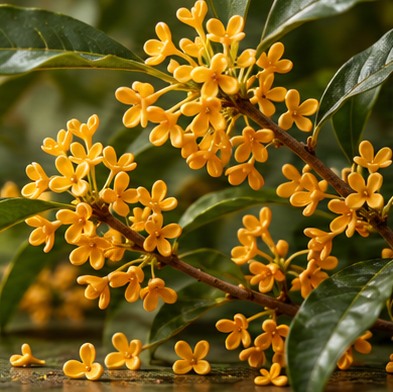
Osmanthus is an especially revealing ingredient because it crosses several familiar scent categories at once. Its perfumery materials can suggest fruit, flowers, tea and leather without resembling a simple fruit cocktail or a conventional bouquet. That complexity makes it useful for understanding why an ingredient’s role cannot always be predicted from the plant’s appearance. A small flower can introduce a surprisingly textured effect into a composition.
What does osmanthus absolute smell like?
IFF describes its osmanthus absolute through dried-apricot, floral, tea and leathery facets. Givaudan similarly connects its material with apricot-like softness and a leathery foundation. These are descriptions of particular supplied materials, not a promise that every finished perfume listing osmanthus will foreground all those aspects. The formula may emphasise a fruity brightness, a floral heart or a drier, suede-like texture.
The flower and the supplied material
Unlike a purely imagined edible note, osmanthus has an established natural perfumery material in the form of an absolute. IFF identifies solvent extraction followed by alcohol purification for its product. Givaudan’s material page identifies flowers as the processed part and China as the origin of that particular material. Those specifications should remain attached to the named supplier’s product, rather than being assumed for every perfume containing an osmanthus note.
Why it connects several fragrance families
An ingredient with fruity and leathery facets can link impressions that might otherwise feel separate. In a floral composition, the fruitiness may give the heart another dimension; beside woods or a leather effect, the same material may feel more textured. This is a way to think about its creative role, not a claim about an undisclosed commercial formula. Contrast and context determine which facets become noticeable.
Its place in current ingredient interest
Perfumer & Flavorist includes osmanthus in its 2026 discussion of growing note interest. That attention does not make it a new discovery: the useful distinction is between renewed visibility and the established use of a material. For a reader exploring current perfume styles, osmanthus offers an alternative to both straightforward sugary fruit and the more familiar rose or jasmine vocabulary.
How to recognise it without forcing a note
Try an osmanthus-led fragrance alongside a peach interpretation and a floral perfume. Notice whether the fruit impression feels juicy, dried or textured by a leathery edge. Then let the composition develop before deciding whether that impression persists. You do not need to identify every facet at once. A careful description of apricot-like fruit against a dry background is more useful than simply copying a long note list.
Common questions
Is osmanthus a flower or a perfume accord?
It is a flowering plant with natural perfumery extracts, including absolutes. A finished perfume’s osmanthus effect may also involve a broader accord.
Why can osmanthus smell leathery?
Leathery facets are documented in supplier descriptions of osmanthus absolute. Their prominence varies with the specific material and the composition around it.
Sources and further reading
Trend reports describe their own markets, measures and observation periods; they are not global sales rankings. Product examples describe the named brands’ published interpretations, without affiliation or endorsement.