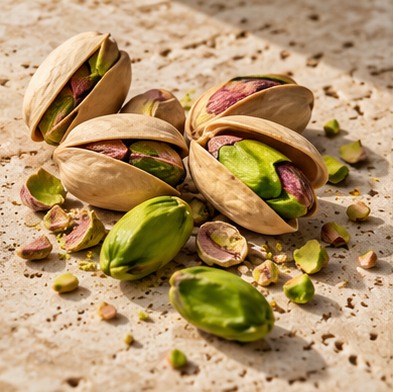
Pistachio is one of the most visible edible notes in current fragrance discussion, but its appeal is more specific than sweetness. A pistachio perfume can suggest a green kernel, a roasted nut, a creamy dessert or a powdery almond-like effect. Those interpretations share a name while offering quite different experiences. Understanding the distinction helps you choose a fragrance for its actual texture rather than for the flavour you imagine from the bottle’s description.
What does pistachio smell like in perfume?
The most useful starting point is the relationship between nuttiness and creaminess. A green interpretation may feel slightly dry and fresh; a dessert interpretation may move toward almond, vanilla and sugar. Roasted effects can add a darker edge. The note is not automatically restrained or automatically sugary. Ask which of these qualities leads the composition, and whether that balance changes after the opening settles.
An accord is different from a nut extract
In a finished fragrance, pistachio commonly names a constructed olfactory idea. It should not be read as proof that pistachio oil or an extract of edible kernels is present. D.S. & DURGA explicitly presents its Pistachio as a gourmand interpretation and lists cardamom, roasted almond, patchouli and vanilla-crème effects around it. That is useful composition context; it is not a published formula for the perfume.
Why the note fits the current gourmand direction
The 2026 trend coverage from Perfumer & Flavorist places pistachio among growing edible-note interests. The interesting creative question is what comes after the recognisable dessert association. A dry woody structure, a green edge or an earthy background can give nuttiness a different setting. Conversely, a perfumer can emphasise cream and sweetness deliberately. Neither approach is inherently more sophisticated; they answer different aesthetic intentions.
How to compare two pistachio fragrances
Begin on separate, labelled blotters and describe each with three words before consulting its note list again. Is the first impression green, toasted or syrupy? Does the later fragrance remain recognisably nutty, or become mainly vanilla and woods? Compare the sweetness with its density: a perfume can feel airy and sweet, or dense and relatively dry. These are independent observations, not a single scale of intensity.
Connections worth exploring
Vanilla helps explain the difference between warmth and overt dessert sweetness. Patchouli introduces another kind of depth: earthy rather than creamy. Sesame offers a neighbouring nutty direction that can feel more toasted or grain-like. Read these relationships as comparisons among finished fragrance experiences, not as instructions to mix raw materials. The goal is a sharper vocabulary for choosing a perfume, rather than a recipe based on familiar foods.
Common questions
Is pistachio perfume always sweet?
No. Pistachio can be interpreted as green, roasted, powdery or dessert-like. The surrounding composition determines how much sweetness you perceive.
Does a pistachio note mean the perfume contains nuts?
The note name cannot establish the ingredient composition or allergen status. Check the specific product’s current documentation when ingredient suitability matters.
Sources and further reading
Trend reports describe their own markets, measures and observation periods; they are not global sales rankings. Product examples describe the named brands’ published interpretations, without affiliation or endorsement.