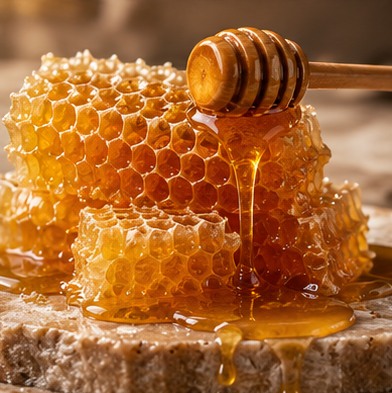
Honey in fragrance can suggest much more than a sweet liquid. It may feel floral, pollen-like, waxy, warm or slightly animalic, depending on the composition. These impressions are useful to separate because a honey perfume does not have to behave like a vanilla dessert. The interest often lies in the connection between flowers and the richer atmosphere around them, rather than in sweetness alone.
Sweetness is only one part of the impression
A honey idea can be bright and nectar-like, dense and waxy, or warmed by a balsamic background. The texture changes the meaning of the sweetness. Waxy softness is different from a syrupy effect; a floral impression is different from a caramelised one. Try to describe which part of the reference you recognise before assuming that every fragrance labelled honey will appeal to the same preference.
Honey, beeswax and the constructed effect
Honey and beeswax are not interchangeable ingredient names, and neither should be inferred automatically from a perfume note. A honey-like atmosphere can be built through an accord. Some perfumes also use beeswax-related materials. The distinction is visible in official product descriptions, which may explain both a scent idea and a particular source material without claiming that the formula contains literal honey.
A documented example: Zoologist Bee
Zoologist presents Bee as a honey-themed composition with floral, waxy and incense-like dimensions, and explicitly states that the perfume contains beeswax. Its perfumer interview describes constructing a honey atmosphere through beeswax absolute and floral materials rather than focusing on literal honey as the starting requirement. This is one product-specific explanation, not a formula that can be generalised to every honey fragrance.
Why honey remains relevant to current gourmands
Spate’s 2026 predicted-trends report lists honey among fragrance-note interests showing growth in its observed US search and social data. The note is especially useful for exploring the border between floral richness and edible sweetness. It can support a recognisable gourmand direction while offering a different texture from the familiar cream-and-vanilla approach. The trend signal concerns attention, not an objective hierarchy of ingredients.
How to choose between nectar and wax
Compare a honey-themed fragrance with rose or jasmine and then with a vanilla perfume. Does it feel closer to flowers, to a warm balsamic impression or to dessert? Return to the blotter later to see whether the waxy texture becomes clearer. Avoid using a note name as a shortcut for vegan or other ingredient-source claims; those require the specific product’s current information. Your sensory preference and a sourcing requirement are separate questions.
Common questions
Does a honey note mean real honey is present?
No. The impression may be constructed. Check the specific fragrance’s documentation for information about source ingredients.
Are honey perfumes vegan?
Some may be and some may not. Beeswax or other source materials cannot be confirmed or excluded from the note name alone.
Sources and further reading
Trend reports describe their own markets, measures and observation periods; they are not global sales rankings. Product examples describe the named brands’ published interpretations, without affiliation or endorsement.