Begin with a question
Sampling works better when you know what you are trying to learn. You might ask whether a woody style feels too dry, whether a floral becomes sweeter over time, or whether you still enjoy a fragrance after the opening settles. A clear question reduces the temptation to decide everything from the first spray.
Keep your comparisons legible
Label blotters so that you do not confuse them. Give each fragrance enough space to be perceived separately, and take breaks when the smells become difficult to distinguish. More samples are not automatically more information. A small set that you can compare thoughtfully is often more useful than a crowded collection of indistinct impressions.
Blotter and skin answer different questions
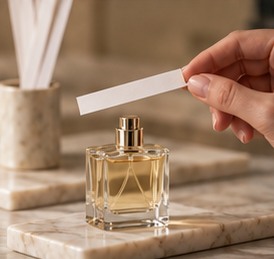
A blotter is useful for a controlled first exploration. A finished product worn as directed lets you evaluate the experience in a wearing context, if it is suitable for your skin. Those experiences need not be identical. Record which context you used so that a later comparison is meaningful. Do not treat a quick blotter test as a complete forecast of a day’s wear.
Observe without inventing a performance rule
Projection and persistence vary with the particular fragrance, application and circumstances. Concentration labels alone do not settle the question. Pay attention to the actual version you are considering and how you experience it over time. Repeated wear can reveal a preference that an exciting first impression obscured.
Buy the experience you return to
A sample does not need to impress you instantly to be informative. Some fragrances become more interesting with familiarity; others reveal that their strongest appeal was a short opening. Keep a few precise notes and return on another day. Choosing a bottle becomes easier when the decision rests on an experience you have repeated, rather than on the pressure of a single moment.